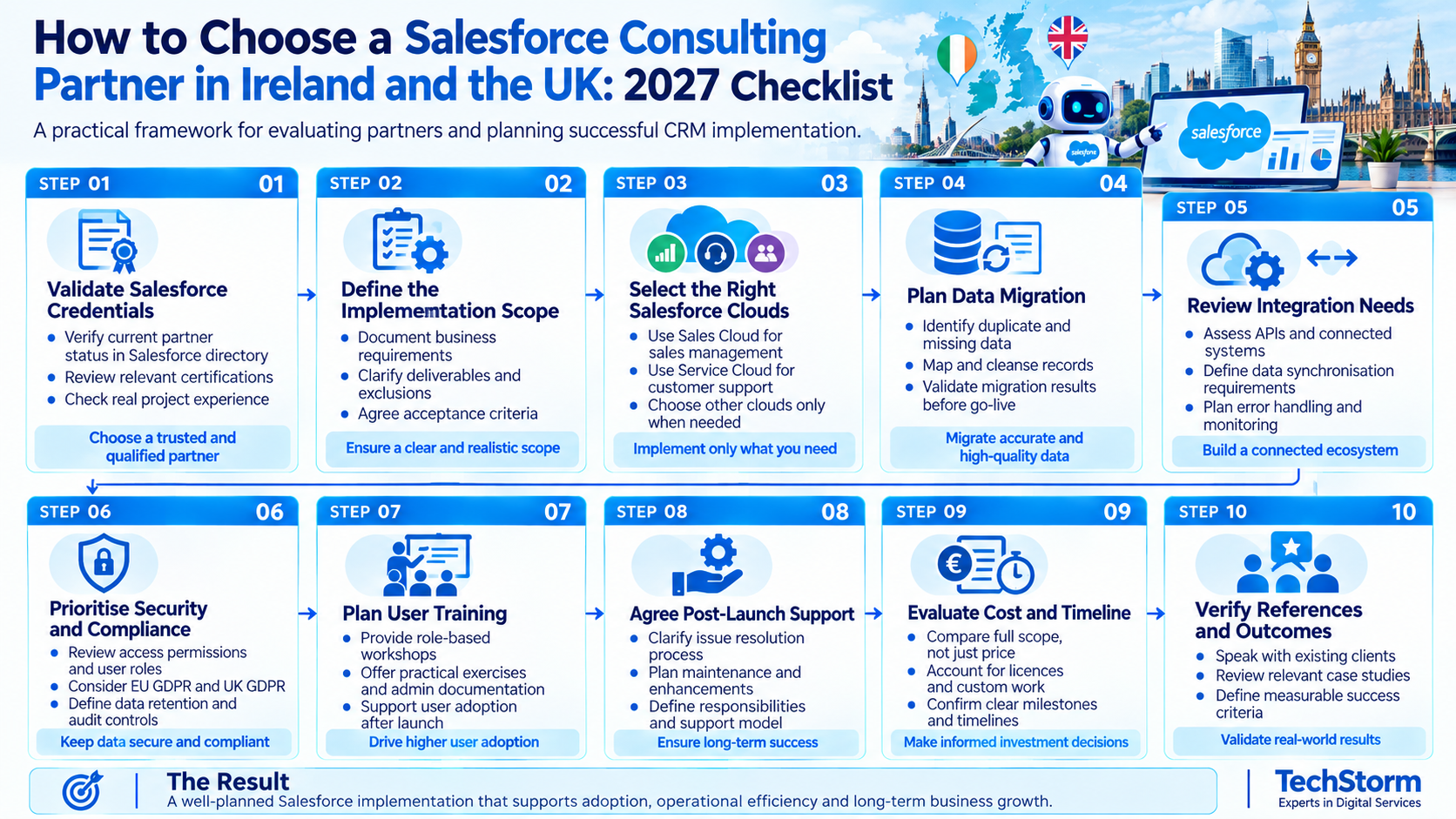
Salesforce Partner Selection – Key Highlights
- Verify credentials: Check current Salesforce partner status and relevant expertise.
- Define the scope: Document requirements, deliverables and responsibilities.
- Plan data migration: Include data cleansing, mapping and validation.
- Prioritise security: Assess permissions, privacy obligations and integrations.
- Plan beyond launch: Include user training and ongoing support.
Choosing a Salesforce consulting partner in Ireland or the UK requires more than comparing quotations or technical certifications. Use this practical 2027 checklist to evaluate implementation experience, CRM planning, data migration, security, training and long-term support.
How to Choose a Salesforce Consulting Partner in Ireland and the UK: 2027 Checklist
Choosing a Salesforce consulting partner in Ireland or the UK requires more than comparing quotations or technical certifications. Businesses should assess implementation experience, Salesforce expertise, data migration capabilities, security practices, user training, and long-term support before signing a contract.
The right partner should understand your business objectives and explain how Salesforce CRM can support measurable operational improvements.
For organisations planning a Salesforce implementation in 2027, this checklist provides a practical framework for evaluating consulting partners and avoiding unnecessary project risks.
Why Salesforce Partner Selection Matters in 2027
Salesforce offers cloud-based capabilities for sales, customer service, marketing, analytics, and business automation.
However, purchasing Salesforce licences does not automatically deliver an effective customer relationship management system.
Organisations must configure the platform around their workflows, prepare existing data, establish access controls, and train employees.
AI-powered capabilities also introduce new considerations involving data quality, governance, automation, and human oversight.
A qualified Salesforce consulting partner helps organisations understand these requirements before committing to a complex implementation.
7 Questions to Ask Before Choosing a Salesforce Consulting Partner
1. Does the Partner Have Recognised Salesforce Credentials?
Begin by reviewing the consultancy's Salesforce partnership status, relevant certifications, and implementation experience.
A Salesforce Crest partner is associated with Salesforce's consulting partner programme. However, organisations should verify current partner credentials through Salesforce's official partner directory.
Credentials provide useful evidence of platform expertise but should not replace technical evaluation, client references, or project-specific discussions.
TechStorm Consulting Ltd. identifies itself as a Salesforce Crest Consulting Partner serving businesses across Ireland and the UK.
Businesses can explore its Salesforce consulting and implementation services to understand its stated capabilities.
2. Can the Partner Explain the Full Implementation Scope?
Salesforce CRM implementation services should begin with business requirements rather than immediate technical configuration.
Ask prospective partners to explain their approach to:
- Business process discovery
- CRM data modelling and configuration
- Existing customer data migration
- Integration with business applications
- User roles and permission management
- Testing and employee training
- Deployment and post-launch support
Request a written scope documenting responsibilities, deliverables, assumptions, and exclusions.
This makes competing proposals easier to compare.
3. Which Salesforce Clouds Does the Business Actually Need?
Not every organisation requires multiple Salesforce products.
Sales Cloud may support sales pipeline management, while Service Cloud addresses customer support workflows.
Marketing Cloud and Experience Cloud serve different engagement and collaboration requirements.
Businesses should select products based on validated operational needs, expected value, licensing implications, and integration requirements.
An effective consultant should explain when a simpler implementation is preferable to a larger deployment.
4. How Will Data Migration and Integration Be Managed?
Customer data may already exist in spreadsheets, accounting systems, marketing platforms, or legacy CRM software.
Before migration, organisations should identify duplicate records, inconsistent formats, missing information, and ownership rules.
The implementation plan should include data mapping, validation, testing, and clear responsibility for resolving migration errors.
Where integration is required, consultants should assess available APIs, security requirements, and data synchronisation.
5. What Security and Compliance Measures Are Included?
Organisations operating across Ireland and the UK should consider applicable data protection obligations, including the EU GDPR and UK GDPR.
Salesforce configuration can support security controls, but compliance also depends on organisational policies, processing arrangements, contractual obligations, and operational practices.
Ask how the partner approaches access permissions, data retention, auditability, and system integrations.
Legal or specialist compliance advice may be necessary for regulated processing activities.
6. How Will Employees Be Trained?
Low user adoption can undermine even a technically successful CRM deployment.
Training should reflect the responsibilities of sales representatives, support teams, managers, and system administrators.
Ask whether the proposed project includes role-based workshops, administrator documentation, practical exercises, and post-launch assistance.
An implementation should also identify how employee feedback will influence future improvements.
7. What Happens After Salesforce Goes Live?
CRM requirements evolve as organisations introduce new services, expand teams, or change internal processes.
Before choosing a partner, clarify what support is included after launch.
Important considerations include issue resolution, administrator assistance, system enhancements, additional integrations, and ongoing optimisation.
Salesforce CRM Implementation: Partner Evaluation Checklist
Use this checklist when comparing proposals from multiple Salesforce implementation providers.
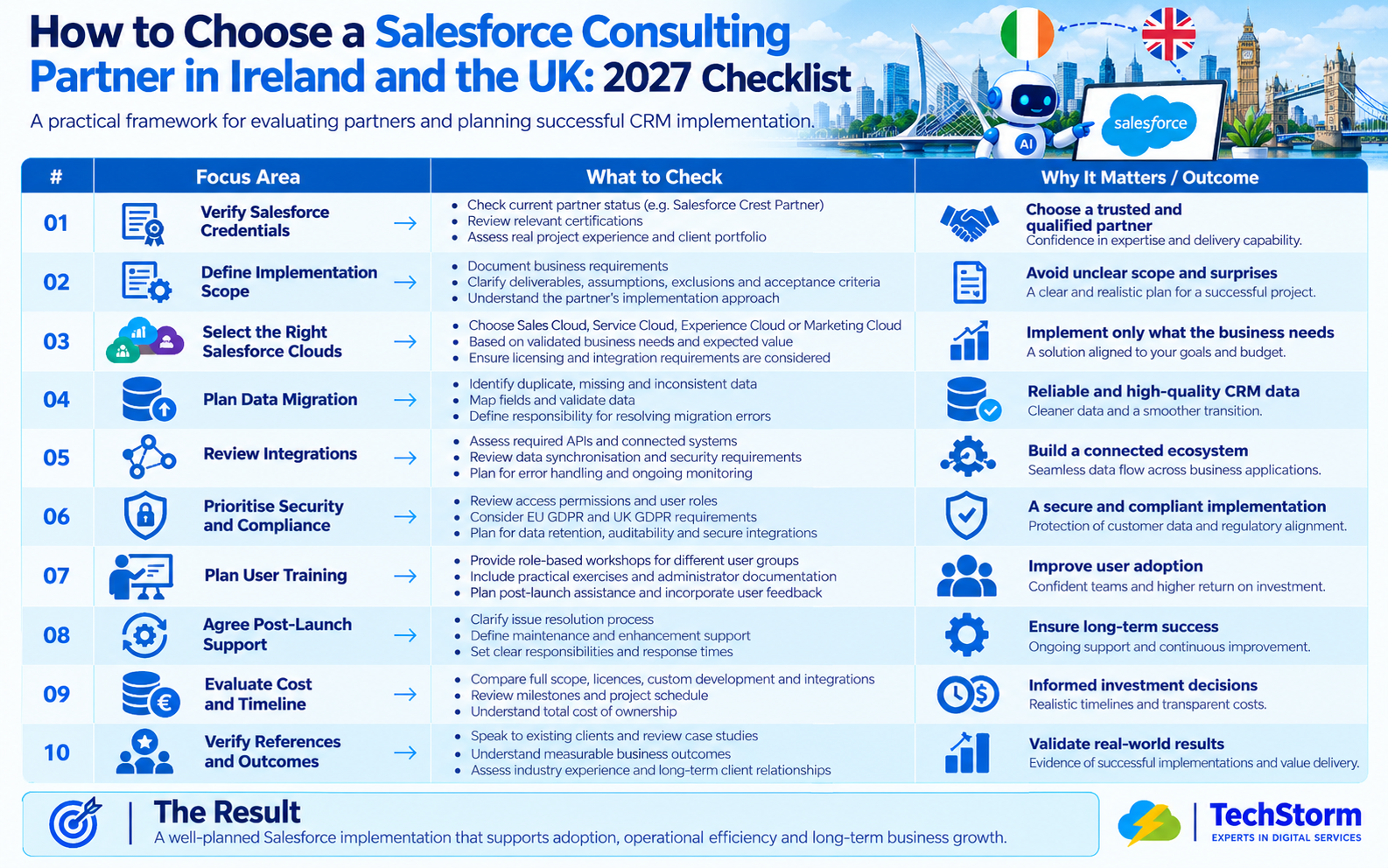
| Evaluation area | What businesses should verify |
|---|---|
| Salesforce credentials | Current partnership and relevant expertise |
| Discovery process | Documented business requirements |
| Implementation | Clear deliverables and acceptance criteria |
| Data migration | Mapping, cleansing and validation |
| Security | Permissions and applicable compliance controls |
| Training | Role-based user enablement |
| Support | Defined post-launch responsibilities |
How Much Does Salesforce CRM Implementation Cost?
Implementation costs depend on project scope, number of users, Salesforce products, data migration complexity, integrations, and custom development.
For smaller projects, a structured QuickStart package may provide a defined starting point.
TechStorm publishes Salesforce QuickStart services, including a Sales Cloud QuickStart offering starting from €2,500 plus VAT.
Organisations should confirm current pricing, inclusions, licensing costs, and any additional work before purchasing.
A lower initial quotation does not necessarily represent the lowest long-term cost.
Why Consider a Dublin-Based Cloud Solution Provider?
Working with a cloud solution provider in Dublin can be useful for Irish businesses that value local market familiarity, accessible communication, and support aligned with their operating environment.
For organisations with operations in both Ireland and the UK, cross-border project coordination is another important consideration.
TechStorm Consulting Ltd. was founded in Dublin in 2016 and provides Salesforce consulting, implementation, integration, and digital transformation services.
Its industry-specific Salesforce solutions cover different organisational requirements, including commercial businesses and nonprofit organisations.
Salesforce Consulting Services from TechStorm
TechStorm supports organisations considering new Salesforce deployments, CRM improvements, cloud integrations, and AI-powered solutions.
Its stated expertise includes Salesforce Sales Cloud, Service Cloud, Marketing Cloud, Experience Cloud, and MuleSoft integration.
Businesses evaluating an implementation can discuss their existing systems, operational challenges, required functionality, and anticipated project scope through the company's contact page.
Dublin Office Address: Base Enterprise Centre, Damastown Road, Mulhuddart, Dublin 15, Ireland.
Email: info@techstorm.ie
Phone: +353 1 962 9946
Final Thoughts
Selecting a Salesforce consulting partner should be a business decision supported by technical due diligence.
For organisations across Ireland and the UK, prioritising implementation quality, data governance, practical training, and ongoing support can help build a CRM system that remains useful as business requirements evolve.
TechStorm provides Salesforce consulting and cloud implementation services for organisations seeking structured digital transformation support.
Planning a Salesforce Implementation?
Discuss your CRM requirements, existing systems, data migration needs, and implementation goals with TechStorm.