Executive Summary & Core Principle
When your business relies on multiple disconnected systems, data silos become inevitable. MuleSoft API-led connectivity breaks these barriers, enabling seamless integration across your Salesforce ecosystem and beyond. This guide explores how strategic API integration transforms system architecture, improves data flow, and accelerates digital transformation initiatives.
API-led connectivity represents a strategic approach to enterprise integration. Rather than building point-to-point connections between systems, this methodology creates reusable APIs organised in layers.
Understanding MuleSoft API-Led Connectivity
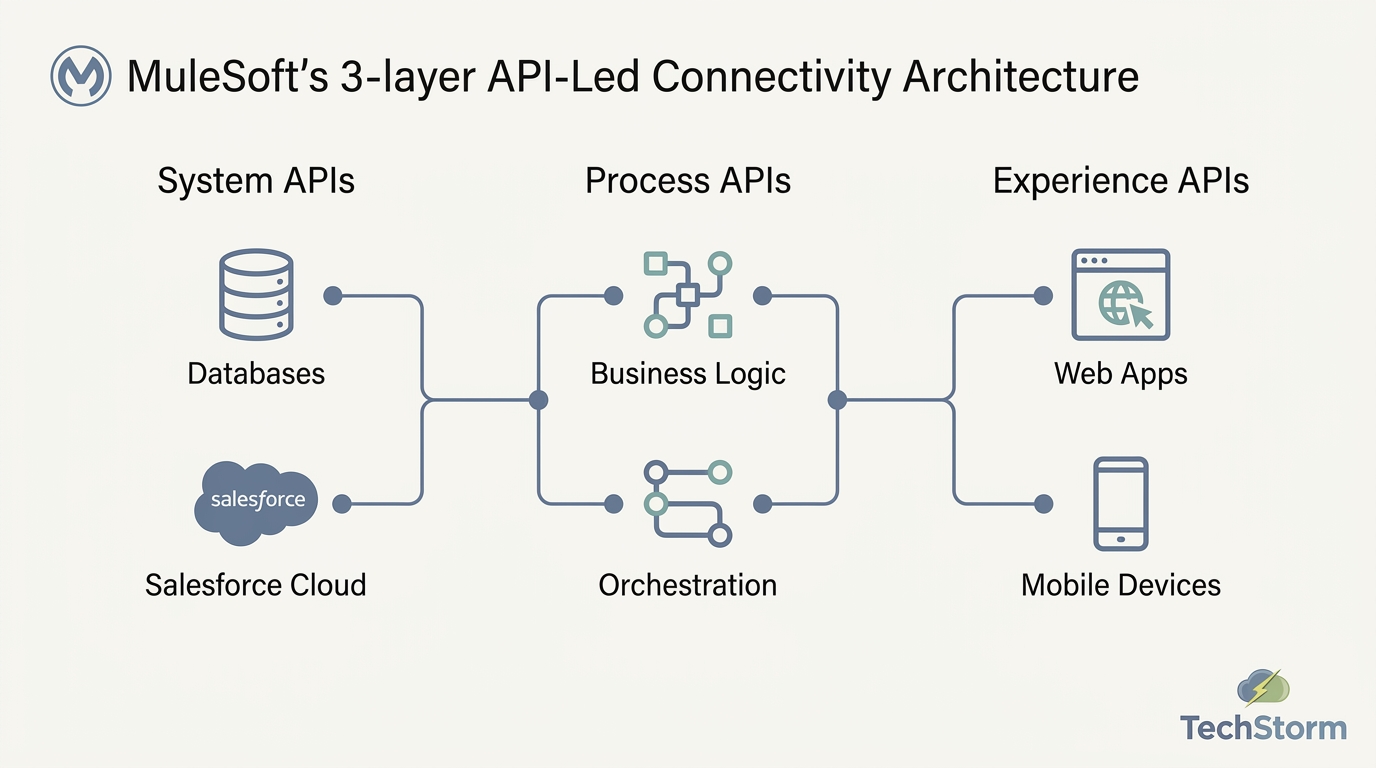
API-led connectivity represents a strategic approach to enterprise integration. Rather than building point-to-point connections between systems, this methodology creates reusable APIs organised in layers: system APIs (accessing backend systems), process APIs (orchestrating business processes), and experience APIs (delivering data to user-facing applications).
This layered architecture provides distinct advantages. System APIs abstract complexity from underlying databases and legacy systems. Process APIs build business logic that coordinates multiple system APIs. Experience APIs expose data through channels that applications consume. The result: improved flexibility, reduced redundancy, and faster time to market for new integrations.
Why MuleSoft for Salesforce Ecosystem Integration
Organisations leveraging Sales Cloud, Service Cloud, Marketing Cloud, or Account Engagement require robust integration capabilities. MuleSoft's pre-built connectors and Anypoint Platform streamline connectivity to Salesforce and third-party systems, reducing implementation complexity.
Key advantages include:
- Native Salesforce connectors with real-time data synchronisation capabilities
- Comprehensive marketplace of integration templates and connectors
- Centralised governance through API management and monitoring
- Scalability supporting enterprise-grade transaction volumes
- Cloud-native architecture reducing infrastructure management overhead
Common Implementation Scenarios
Educational Institutions
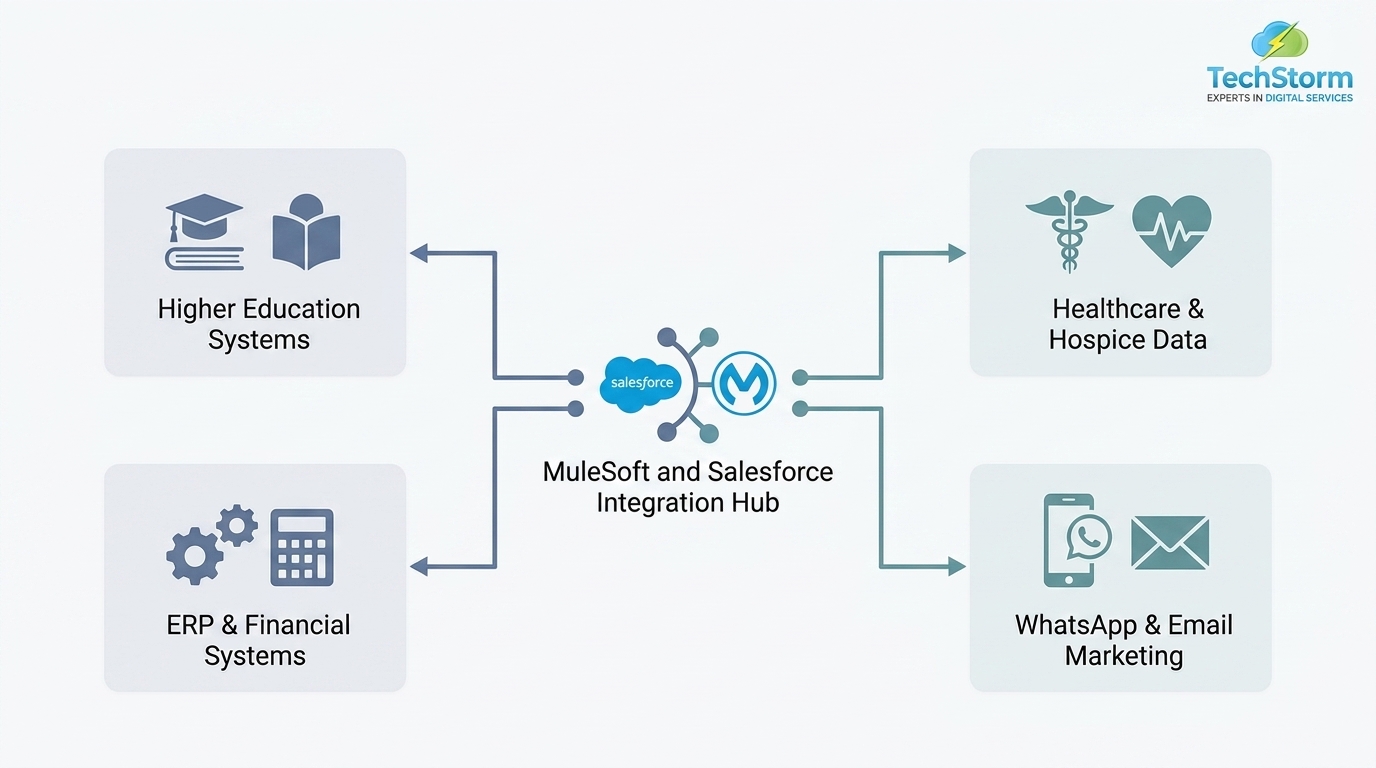
Universities and educational organisations manage complex data ecosystems spanning student information systems, learning management platforms, finance systems, and Salesforce ecosystems for admissions and alumni engagement. MuleSoft enables seamless data flow between these systems, allowing admissions teams to access real-time student status while financial systems maintain accurate enrollment data. Integration with Account Engagement facilitates automated nurture campaigns for prospective students across different programme stages.
Hospice and Healthcare Sector
Healthcare providers managing patient data across Service Cloud, clinical systems, billing platforms, and care coordination tools benefit significantly from API-led integration. Secure data exchange enables patient records to synchronise across touchpoints while maintaining compliance requirements. Integration with communication platforms ensures care teams receive timely alerts without manual intervention.
Multi-Sector Enterprise Environments
Organisations across sectors require integration spanning Sales Cloud for customer management, Service Cloud for support operations, Marketing Cloud for campaign execution, and specialized systems for industry-specific functions. MuleSoft's flexibility supports these complex scenarios, enabling data to flow consistently while applying business rules specific to each functional area.
Strategic Platform Integrations
Modern business technology stacks extend beyond Salesforce. MuleSoft integrates seamlessly with platforms your organisation already depends on:
| Integration Type | Business Impact | Implementation Focus |
|---|---|---|
| WhatsApp Business Integration | Real-time customer communication from Service Cloud interactions | Message routing, contact synchronisation, automation |
| Mailchimp Email Marketing | Unified customer data driving targeted email campaigns | List management, contact sync, engagement tracking |
| ERP System Connectivity | Real-time order-to-cash and procurement visibility | Data transformation, transaction routing, error handling |
| Legacy System Modernisation | Extending functionality without replacing established systems | API abstraction, data mapping, gradual migration |
Implementation Considerations for Success
Discovery and Scoping
Effective API integration begins with thorough system discovery. Understanding data flows, identifying transformation requirements, and mapping business processes provides the foundation for design decisions. This phase clarifies which data should flow through which APIs, determines authentication requirements, and identifies potential bottlenecks before implementation begins.
Configuration and Data Mapping
Each system maintains unique data structures and naming conventions. Configuration and data mapping translates between these formats, ensuring consistency across your technology landscape. This includes determining field-level transformations, establishing lookup mechanisms, and handling exceptions when systems contain conflicting information.
Training and Enablement
Technical staff supporting integrated systems require training covering API fundamentals, monitoring and troubleshooting practices, and operational procedures. Business teams benefit from understanding how integrations support their processes and where to escalate issues. Documentation becomes critical for long-term system stability and knowledge transfer.
Quick Start Deployments
Accelerated implementation approaches using templates and proven patterns reduce initial deployment timeframes. Starting with core use cases allows teams to deliver early value while building organisational expertise for subsequent integration phases.
Building Topical Authority Through Integration Strategy
Many organisations approach integration project-by-project, creating silos that repeat work across initiatives. Strategic integration architecture, enabled through MuleSoft, treats APIs as reusable business assets. Sales APIs developed for one initiative become foundation components for future projects. This approach reduces redundancy, improves consistency, and accelerates subsequent implementations.
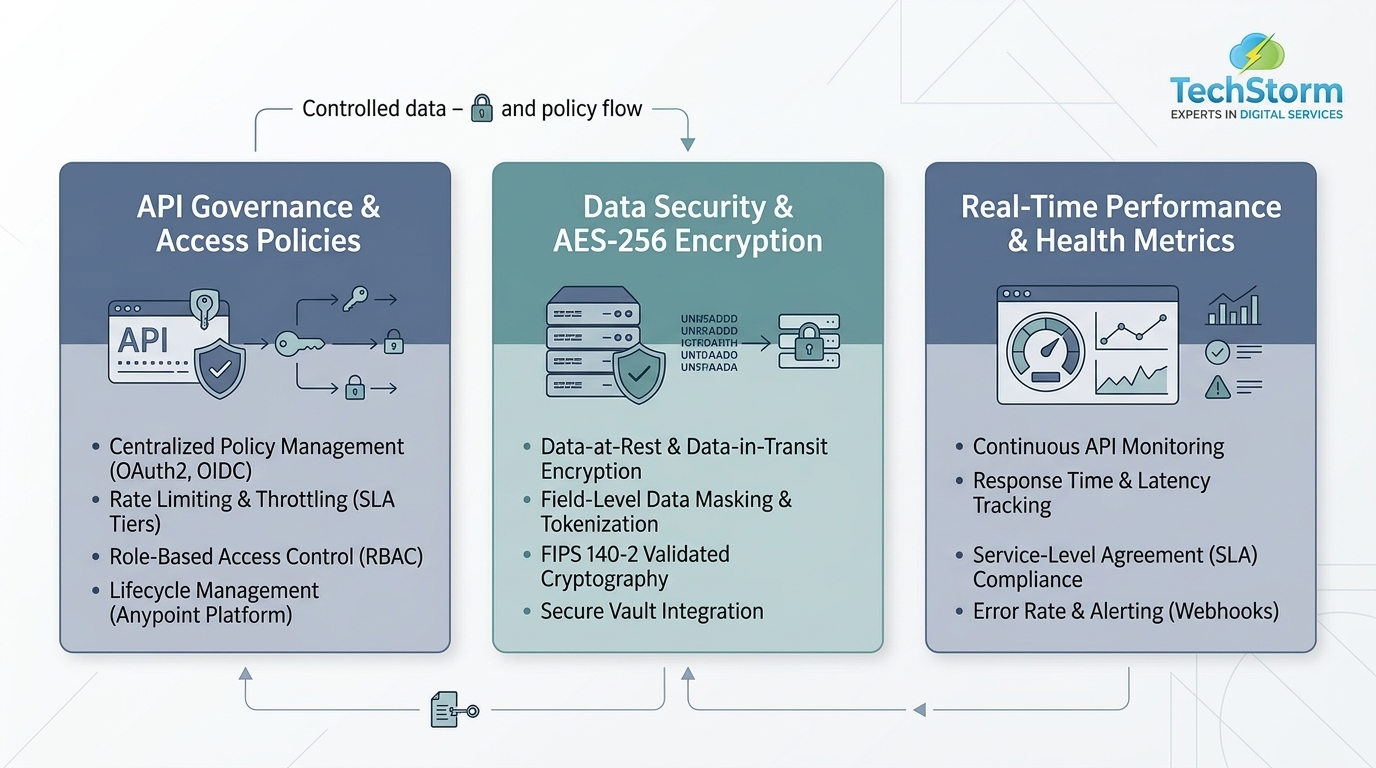
A trusted MuleSoft implementation partner helps establish this architecture, ensuring decisions made early support organisational growth without costly rework. This includes designing API governance policies, establishing monitoring practices, and building internal capabilities for ongoing management.
Data Governance and Security in Integrated Environments
Integration creates new data pathways requiring robust governance. API management platforms provide visibility into what data flows where and establish policies around access control. Encryption in transit, authentication mechanisms, and audit logging ensure sensitive information receives appropriate protection. For healthcare and education sectors managing regulated data, these considerations become foundational to compliance success.
Monitoring and Continuous Optimization
Deployed integrations require ongoing monitoring and optimisation. Real-time dashboards highlight performance issues and failed transactions requiring attention. Monitoring data identifies optimisation opportunities where performance can improve or error rates can decrease. This operational perspective ensures integrations continue supporting business objectives as volume scales and requirements evolve.
Getting Started With MuleSoft Integration
Successful integration initiatives begin with clear objectives. Whether enabling real-time customer data across Sales Cloud and Service Cloud, connecting Marketing Cloud to external tools for comprehensive campaign orchestration, or modernising legacy systems through API layers, starting with achievable goals builds momentum and organisational confidence.
Strategic integration services guide organisations through discovery, design, implementation, and optimisation phases. Rather than treating integration as purely technical infrastructure, positioning it as a business capability that enables strategic initiatives transforms how digital transformation unfolds.
The combination of clear requirements, proven methodologies, and experienced implementation partners creates conditions for integration success. MuleSoft provides the platform; strategic guidance ensures it delivers business outcomes.
Why Partner With TechStorm for MuleSoft Implementation
TechStorm brings deep expertise across MuleSoft implementations, Salesforce ecosystems spanning Sales Cloud, Service Cloud, Marketing Cloud, and Account Engagement, plus specialized knowledge supporting educational and healthcare sectors. Rather than generic consulting approaches, our implementation methodology focuses on your specific integration challenges, architectural requirements, and business outcomes.
Discover how strategic MuleSoft integration can address your system integration challenges. We arrange discovery calls to understand your environment and recommend implementation approaches matched to your requirements and capabilities.
About TechStorm: We deliver Salesforce and MuleSoft integration solutions for organisations across education, healthcare, and enterprise sectors throughout Ireland. Our implementation expertise spans system architecture, data strategy, and operational enablement.