Quick Answer
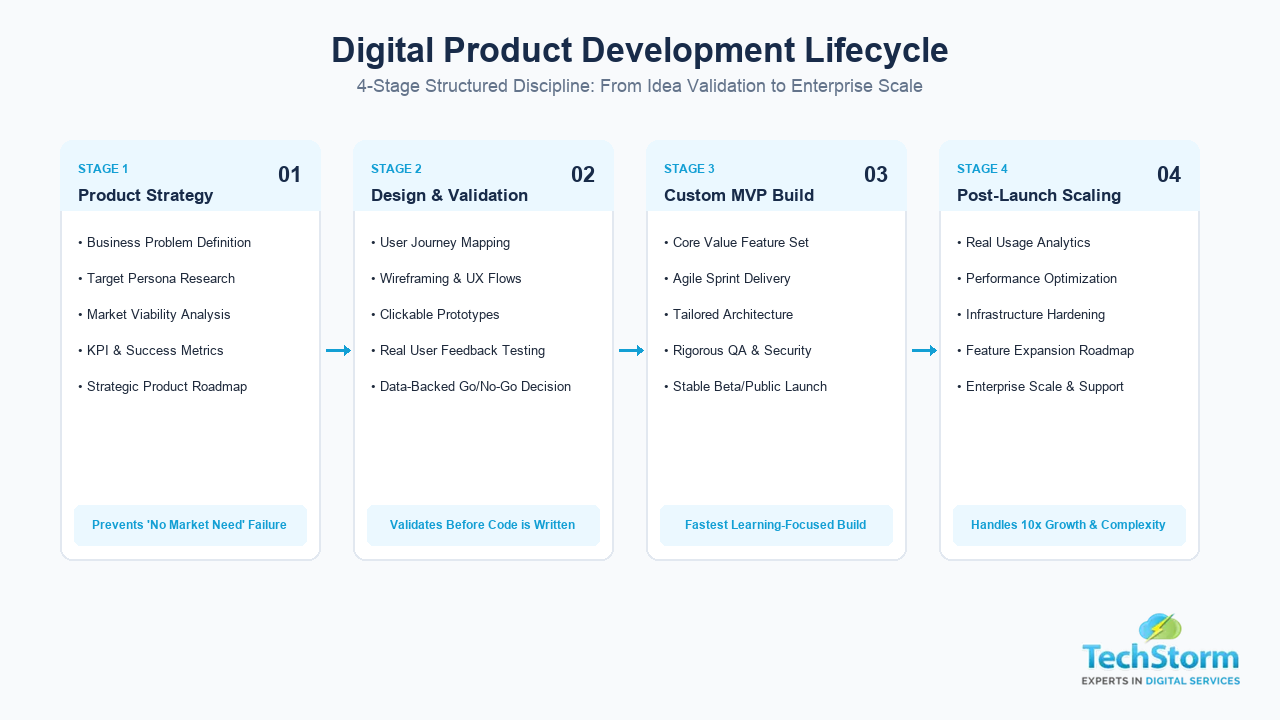
Digital product development is the structured process of turning a business idea into a working software product, app, or platform. It covers four stages: product strategy, design and validation, custom software build (usually starting with an MVP), and post launch scaling. Most projects fail not because of bad code, but because a team skips strategy and validation and jumps straight to building.
If you are researching this term, you are probably trying to decide one of three things: whether your idea is worth building, how much it will cost, or which type of partner (freelancer, in-house team, or agency) can actually deliver it. This guide answers all three, in order.
Why Digital Product Development Matters Right Now
Every business, from an early stage startup to an established enterprise, eventually needs to build something digital: an internal tool, a customer facing app, or a full SaaS platform. The businesses that get real return on that investment treat it as a product discipline, not a one off coding project.
According to CB Insights research on why startups fail, "no market need" is consistently the top cause, ahead of running out of cash. That single data point explains why product strategy and validation now come before a single line of code is written in any serious digital product development services engagement.
The Digital Product Development Process, Step by Step
A reliable process looks roughly the same whether you are building a mobile app, a web platform, or an internal enterprise tool.
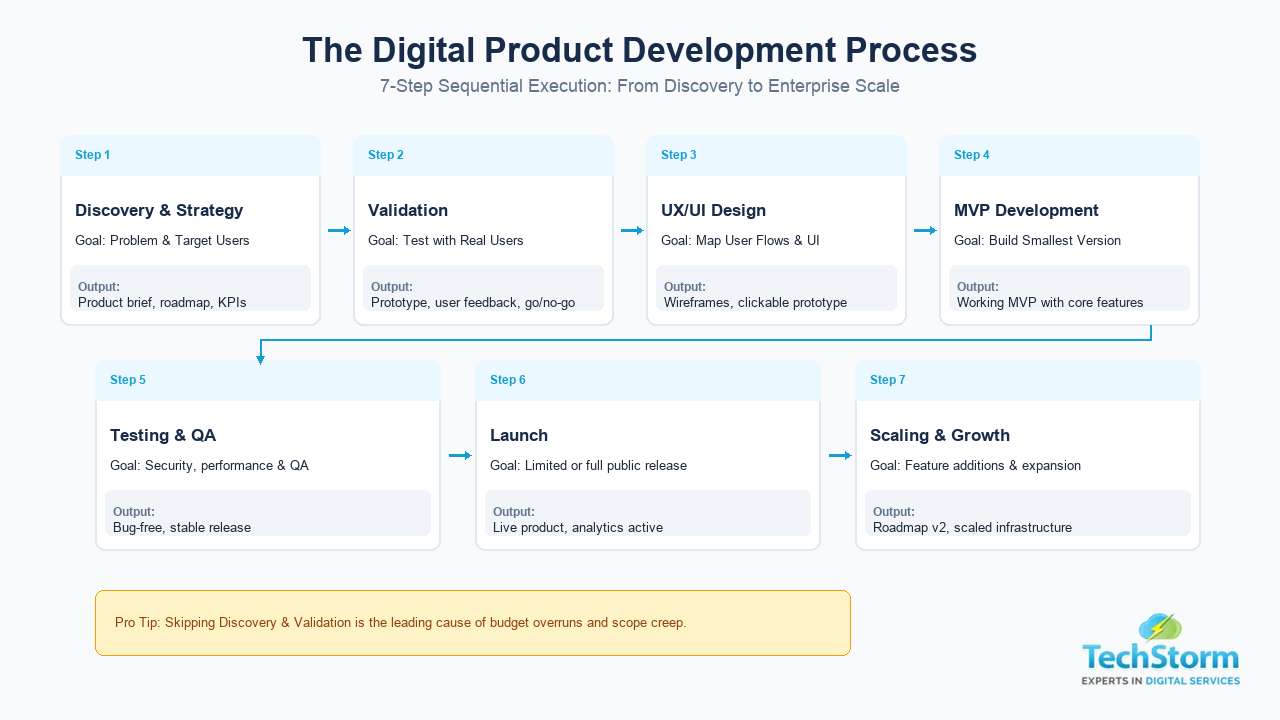
Following a disciplined, sequential roadmap ensures that product risks are mitigated upfront before major capital is committed to software engineering.
| Step | What Happens | Typical Output |
|---|---|---|
| 1. Discovery and strategy | Define the business problem, target users, and success metrics | Product brief, roadmap, KPIs |
| 2. Validation | Test the idea with real users before writing code | Prototype, user feedback, go/no go decision |
| 3. Design (UX/UI) | Map user flows and design the interface | Wireframes, clickable prototype |
| 4. MVP development | Build the smallest version that proves the core value | Working MVP with core features only |
| 5. Testing and QA | Check functionality, security, and performance | Bug free, stable release |
| 6. Launch | Release to a limited or full audience | Live product, analytics in place |
| 7. Scaling | Add features, improve performance, grow the user base | Roadmap v2, scaled infrastructure |
Critical Note: Skipping steps 1 and 2 is the single most common reason budgets run over and timelines slip. It is also the step most agencies quietly skip because it does not look like "progress" to a client watching a dashboard.
Core Digital Product Development Services Explained
Most agencies bundle their offering into four related services. Understanding the difference helps you scope your project correctly and avoid paying for work you do not need yet.
1. Digital Product Development Services (the umbrella)
This is the end to end service: strategy, design, engineering, and scaling under one roof. It suits founders and businesses who want one accountable partner instead of managing a designer, a developer, and a project manager separately. If this is the stage you are at, our digital product development services page breaks down how we structure engagements and what each phase costs.
2. Custom Software Product Development
This is the engineering layer: building software tailored to your exact workflow, rather than configuring an off the shelf tool. It is the right call when your process is genuinely different from your competitors, when you need to integrate with legacy systems, or when a SaaS subscription model does not fit your margins long term.
3. Product Strategy and Innovation Consulting
Before any code is written, strategy consulting answers questions like: is this idea viable, who is the real user, and what is the smallest version that proves value. Skipping this step is the leading cause of wasted development budget, and it is usually cheaper than most founders expect relative to the cost of building the wrong thing.
4. MVP Development and Scaling
An MVP (minimum viable product) is built to test one core assumption with real users, fast. Scaling is the separate, later phase where you add features, harden security, and rebuild infrastructure to handle real growth. Treating these as one phase is another common mistake: an MVP's codebase is rarely meant to survive unchanged at 10x usage, and a good partner tells you that upfront instead of overselling a "perfect" first build.
In House Team vs Freelancer vs Agency: Which Fits Your Project
Choosing the right delivery model dictates project velocity, operational overhead, and long-term maintainability.
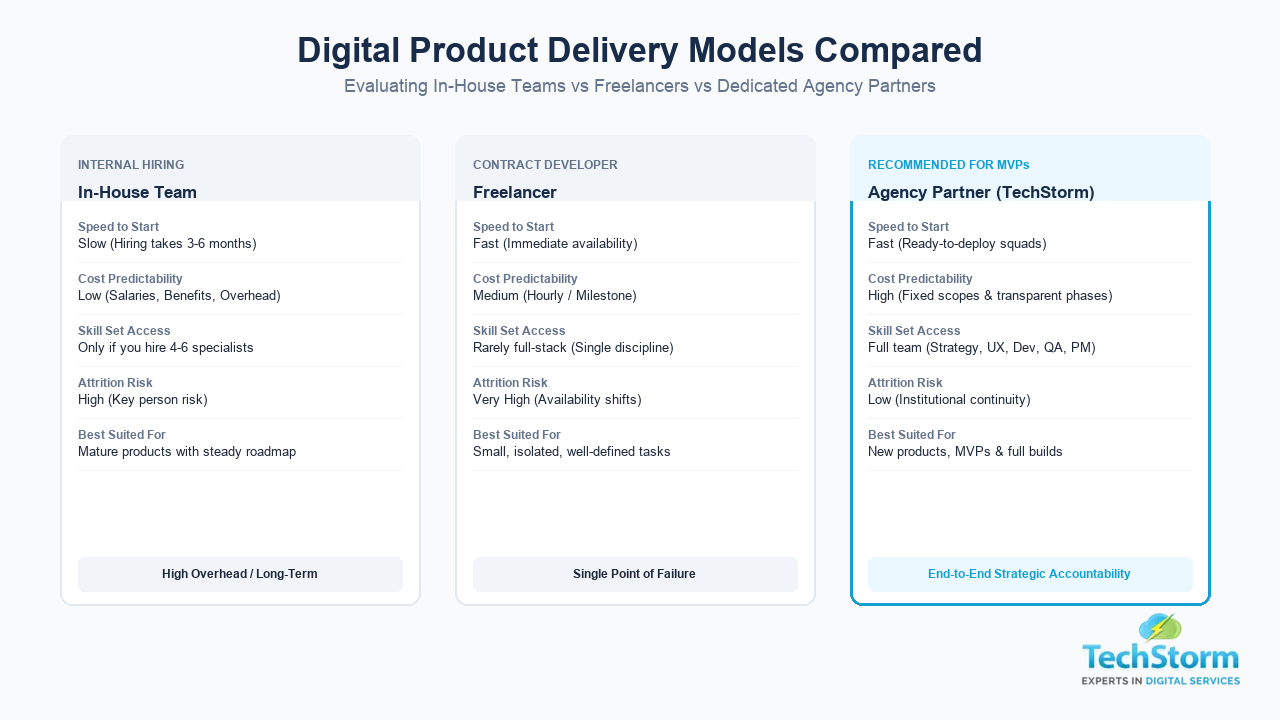
Reviewing comparative trade-offs across talent availability, risk profile, and speed-to-start ensures optimal resource allocation.
| Factor | In House Team | Freelancer | Agency Partner |
|---|---|---|---|
| Speed to start | Slow (hiring takes months) | Fast | Fast |
| Cost predictability | Low (salaries, benefits, tools) | Medium | High (fixed scopes/retainers) |
| Access to full skill set (strategy, UX, dev, QA) | Only if you hire 4-6 roles | Rare, one person | Standard |
| Risk if one person leaves | High | Very high | Low |
| Best for | Mature products with steady roadmaps | Small, well defined tasks | New products, MVPs, and full builds |
There is no universally "best" option here. The right choice depends on how well defined your requirements already are and how much strategic guidance you need versus pure execution.
Original Insight: The Three Mistakes We See Most Often
After running product discovery calls across software, web, mobile app, and design projects, three patterns show up again and again:
- Building for a persona no one validated. Teams design for an assumed "ideal user" without ever interviewing five real prospects. It is the fastest way to build a beautiful product nobody uses.
- Treating MVP as a smaller version of the final product, instead of a separate, learning focused build. This inflates both cost and timeline in the first release.
- Choosing a tech stack for resume value, not maintainability. The trendiest framework is rarely the right one if it is hard to hire for or expensive to maintain two years later.
Avoiding these three mistakes alone tends to save more budget than any amount of negotiating on hourly rates.
How to Choose a Digital Product Development Partner
Use this short checklist during a discovery call:
- Do they ask about your business goals before talking about tech stack?
- Can they show past products they built, not just designs they delivered?
- Do they separate MVP development and scaling into distinct phases with distinct pricing?
- Do they offer product strategy and innovation consulting, or do they jump straight to a build quote?
- Is their team structure (PM, designer, developers, QA) clear, or is it one generalist wearing every hat?
If you want a partner who runs product strategy, custom software product development, and MVP development and scaling under one accountable process, our team can walk you through it on a free discovery call.
Key Takeaways
- Digital product development is a four stage discipline: strategy, validation, build, and scale, not just "writing code."
- Skipping strategy and validation is the most common and most expensive mistake.
- MVP development and custom software product development solve different problems and should be scoped separately.
- The right partner (in house, freelance, or agency) depends on how defined your requirements already are, not on price alone.
If you are ready to move from idea to a validated plan, a short discovery call is usually the fastest way to get clarity on scope, timeline, and cost before committing to a full build.